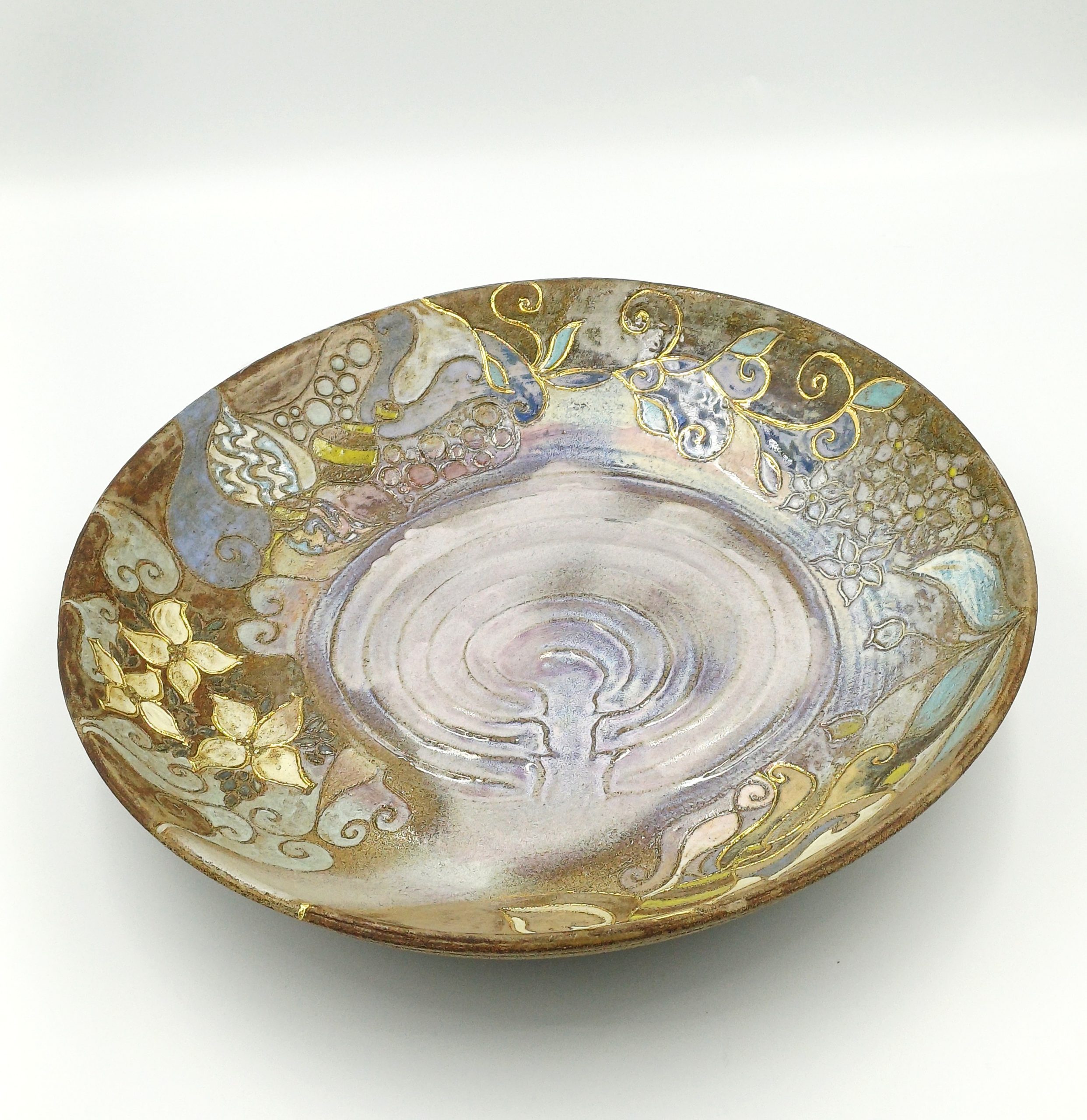
Rahu’s and Ketu’s labyrinth differ from the other seven in that they have no center. In a certain sense, they are not labyrinths at all, since they are not constructed like the others. Thus, we simply pass through them from one side to the other; in other words, the center of the labyrinth—as a quiet space—does not exist here. These two labyrinths also lack their own mirror images. With them, we speak of receptive and expressive movement. In many ways, they are very similar. The fact is that the simultaneous use of both labyrinths most effectively stimulates all their positive and negative qualities and their influence on the surroundings.
Pottery art clay design by Polona Zajc
Polona Zajc’s pottery art features products adorned with the labyrinth symbol. Ceramics are a more than suitable material for depicting labyrinth symbols. Since there are nine forms of labyrinths—seven of which have mirror images—it is possible to represent the basic forms of labyrinths in as many as fourteen different ways. Each also has its own distinctive color, making the design of these symbols a real creative endeavor. These labyrinths—symbols of power—thus add value to Polona Zajc’s pottery art creations.
Labyrinth of transformation
The Labyrinth of Transformation represents the realization that the only constant in this world is change. Since Rahu’s labyrinth has no center—as we simply pass through its form from one side to the other—it points to the absence of a goal. There is neither purpose nor goal; there is only the fact that we are constantly changing. It stimulates all kinds of change within us, and the time to use it comes during difficult life situations, when our lives are turned upside down. It yields good results when there is general confusion and mental fogginess. It also helps with mental disorders, nightmares, hallucinations, and other unusual experiences. The Labyrinth of Transformation is useful for its surroundings because it helps eliminate violence. It is therefore suitable for use in prisons or in urban neighborhoods where violence is on the rise. In a spiritual sense, the labyrinth is extremely important, as its nature points to the fact that life ends when we stop changing.
The Labyrinth of Freedom
The Labyrinth of Freedom erases boundaries and uproots patterns. In doing so, it also brings about transformation—one that is even more purposeful, systematic, and thorough. Navigating this labyrinth will lead us to a place beyond where we are now. In this sense, Ketu’s labyrinth is entirely spiritual. Expressive movement through this labyrinth will deepen mental acuity, logic, mathematical abilities, and insight. Receptive movement, on the other hand, will help dispel fear, panic, unease, and restlessness. It will be used by people under great stress. The environment where this labyrinth is located becomes open to deep inner insights, and people in its vicinity become wiser. The Labyrinth of Freedom represents those at the bottom of the social ladder; it is connected to spiritual beings and animals. Where Ketu’s labyrinth is present, a positive influence on nature and a balanced relationship among different animal species can be felt.
We use cookies on our website to give you the most relevant experience by remembering your preferences and repeat visits. By clicking “Accept”, you consent to the use of ALL the cookies.
This website uses cookies to improve your experience while you navigate through the website. Out of these, the cookies that are categorized as necessary are stored on your browser as they are essential for the working of basic functionalities of the website. We also use third-party cookies that help us analyze and understand how you use this website. These cookies will be stored in your browser only with your consent. You also have the option to opt-out of these cookies. But opting out of some of these cookies may affect your browsing experience.
Necessary cookies are absolutely essential for the website to function properly. These cookies ensure basic functionalities and security features of the website, anonymously.
Piškotek
Trajanje
Opis
cookielawinfo-checkbox-analytics
11 months
This cookie is set by GDPR Cookie Consent plugin. The cookie is used to store the user consent for the cookies in the category "Analytics".
cookielawinfo-checkbox-functional
11 months
The cookie is set by GDPR cookie consent to record the user consent for the cookies in the category "Functional".
cookielawinfo-checkbox-necessary
11 months
This cookie is set by GDPR Cookie Consent plugin. The cookies is used to store the user consent for the cookies in the category "Necessary".
cookielawinfo-checkbox-others
11 months
This cookie is set by GDPR Cookie Consent plugin. The cookie is used to store the user consent for the cookies in the category "Other.
cookielawinfo-checkbox-performance
11 months
This cookie is set by GDPR Cookie Consent plugin. The cookie is used to store the user consent for the cookies in the category "Performance".
viewed_cookie_policy
11 months
The cookie is set by the GDPR Cookie Consent plugin and is used to store whether or not user has consented to the use of cookies. It does not store any personal data.
Functional cookies help to perform certain functionalities like sharing the content of the website on social media platforms, collect feedbacks, and other third-party features.
Performance cookies are used to understand and analyze the key performance indexes of the website which helps in delivering a better user experience for the visitors.
Analytical cookies are used to understand how visitors interact with the website. These cookies help provide information on metrics the number of visitors, bounce rate, traffic source, etc.
Advertisement cookies are used to provide visitors with relevant ads and marketing campaigns. These cookies track visitors across websites and collect information to provide customized ads.